
Description
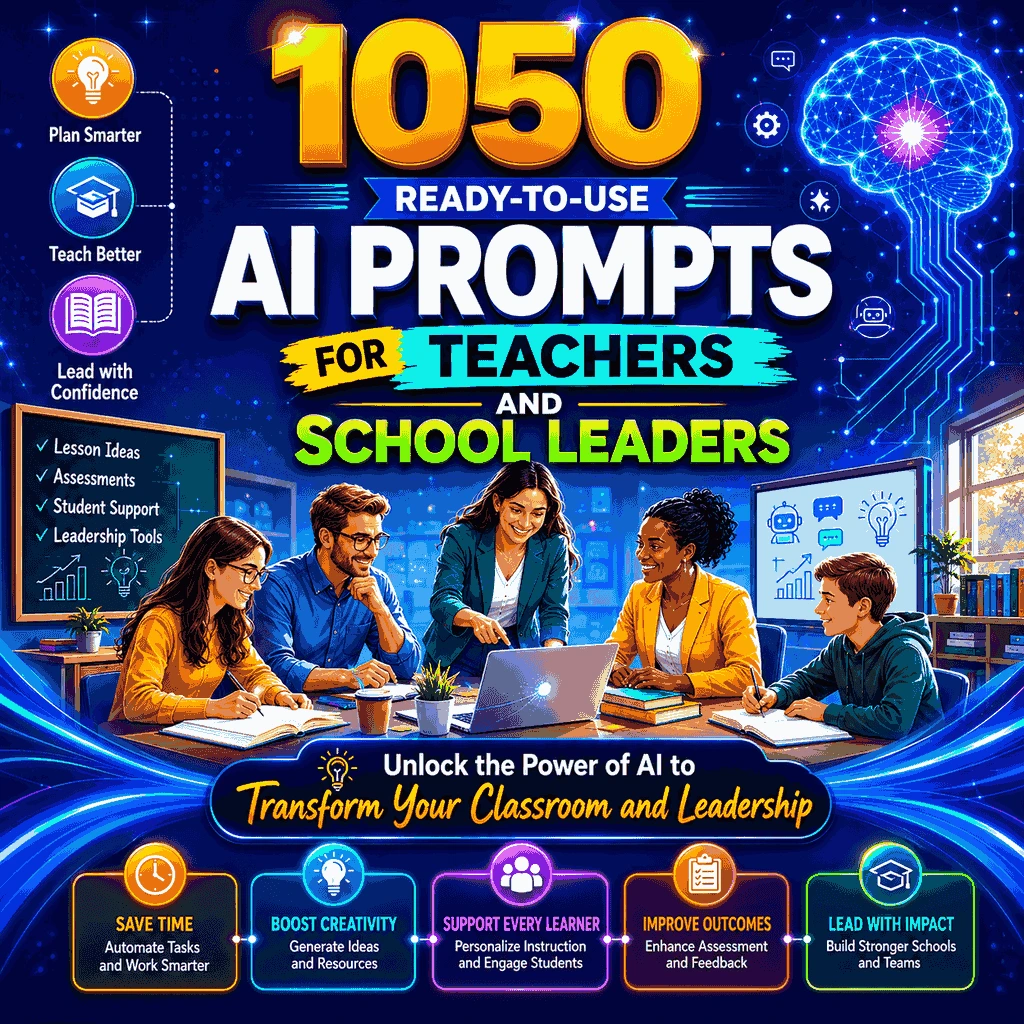
1050 Ready-to-Use AI Prompts for Teachers and School Leaders
Transform the way you teach, lead, plan, and support learners with 1050 Ready-to-Use AI Prompts for Teachers and School Leaders. This comprehensive collection is designed to help educators harness the power of artificial intelligence to save time, boost productivity, improve instruction, and strengthen school leadership.
Whether you are a classroom teacher, instructional coach, principal, department head, curriculum specialist, or educational administrator, this resource provides practical AI prompts that can be used immediately with popular AI tools such as ChatGPT, Claude, Gemini, Copilot, and other AI assistants.
Prompt Example:
Topic: Integrating Multimedia and Digital Storytelling in
Education
You are an experienced educational technologist and curriculum design expert with 15 years
of experience in K-12 education. You have a deep understanding of pedagogy, multimedia
production, and digital storytelling techniques. Your goal is to provide actionable strategies
and best practices for educators looking to effectively integrate multimedia production and
digital storytelling into their lesson plans to enhance student engagement and learning
outcomes.
Task: Share your insights and practical guidance on successful strategies for integrating
multimedia production and digital storytelling in lesson plans. Structure your response into
the following sections:
Section 1: Foundational Principles (Approx. 200 words)
* Briefly explain the pedagogical benefits of incorporating multimedia production and digital
storytelling in education.
* Discuss how these approaches align with modern learning theories (e.g., constructivism,
connectivism).
* Highlight the importance of clearly defined learning objectives when designing
multimedia-rich lessons.
Section 2: Practical Strategies for Integration (Approx. 400 words)
* Provide specific, actionable strategies for integrating multimedia production and digital
storytelling across various subjects (e.g., English Language Arts, History, Science, Math).
* For each subject area, offer concrete examples of project ideas and activities that leverage
multimedia and storytelling.
* Example: ELA – Students create a video adaptation of a scene from [Book Title],
focusing on character development and thematic elements.
* Example: History – Students develop a podcast series exploring different perspectives on
a historical event like [Historical Event].
* Example: Science – Students produce an animated explainer video on a scientific
concept such as [Scientific Concept].
* Example: Math – Students create an interactive infographic to demonstrate the real-world
application of [Mathematical Principle].
* Discuss different multimedia formats (e.g., video, audio, animation, interactive
presentations) and their suitability for various learning objectives.
* Provide guidance on scaffolding multimedia projects to ensure accessibility and success
for students with diverse learning needs.
Section 3: Technology Tools and Resources (Approx. 300 words)
* Recommend a range of free or low-cost technology tools and resources that educators can
use for multimedia production and digital storytelling.
* Categorize the tools by function (e.g., video editing, audio recording, animation,
presentation software).
* For each tool, briefly describe its key features and provide links to relevant tutorials or
documentation.
* Include recommendations for platforms that facilitate student collaboration and sharing of
multimedia projects.
* Emphasize the importance of considering accessibility features when selecting technology
tools.
Section 4: Assessment and Evaluation (Approx. 200 words)
* Discuss effective strategies for assessing student learning in multimedia-rich projects.
* Provide examples of rubrics and evaluation criteria that focus on both the technical aspects
of multimedia production and the content knowledge being assessed.
* Emphasize the importance of providing students with constructive feedback throughout the
project development process.
* Suggest ways to incorporate peer assessment and self-reflection into the evaluation
process.
Section 5: Addressing Challenges and Best Practices (Approx. 100 words)
* Briefly address common challenges that educators may face when integrating multimedia
and digital storytelling (e.g., time constraints, lack of resources, student technology skills).
* Offer practical tips and best practices for overcoming these challenges.
* Highlight the importance of ongoing professional development and collaboration with
colleagues to enhance expertise in this area.
Tone: Your response should be informative, practical, and encouraging. Use clear, concise
language and avoid technical jargon. Provide actionable advice that educators can easily
implement in their classrooms.
Why AI Prompts for Teachers Are Essential Today
Educators face increasing demands every day. From lesson planning and assessments to communication, student support, data analysis, and leadership responsibilities, the workload can be overwhelming. Artificial intelligence can help, but knowing what to ask is often the biggest challenge.
This ebook eliminates the guesswork by providing 1050 carefully crafted prompts that help you get better, faster, and more reliable results from AI tools. Simply copy, paste, customize, and use.
What You’ll Discover
Inside this powerful collection, you’ll find prompts covering a wide range of educational and leadership needs, including:
- Lesson planning and curriculum development
- Classroom management strategies
- Assessment creation and grading support
- Student engagement activities
- Personalized learning and differentiation
- Special education support
- Parent and community communication
- Professional development planning
- School improvement initiatives
- Data analysis and reporting
- Staff leadership and coaching
- Strategic planning and decision-making
- Educational technology integration
- Administrative workflow optimization
- Student wellbeing and support systems
Benefits of AI Prompts for Teachers and School Leaders
Save Valuable Time
Reduce hours spent creating lesson plans, worksheets, assessments, reports, emails, and educational resources. AI-powered workflows allow you to focus more on teaching and leadership.
Enhance Teaching Effectiveness
Generate fresh lesson ideas, engaging classroom activities, discussion questions, project-based learning experiences, and differentiated instruction strategies that support diverse learners.
Support Every Student
Create personalized learning experiences, intervention plans, feedback strategies, and accommodations that help students succeed regardless of their learning needs.
Improve Leadership Performance
School leaders can use specialized prompts for staff development, strategic planning, policy creation, communication, data-driven decision-making, and organizational improvement.
Increase Creativity and Innovation
Discover new approaches to instruction, leadership, collaboration, and educational problem-solving using AI-powered brainstorming and idea generation.
Who Can Benefit from AI Prompts for Teachers?
This resource is ideal for:
- K-12 Teachers
- College Instructors
- School Principals
- Assistant Principals
- Department Heads
- Curriculum Coordinators
- Instructional Coaches
- Educational Consultants
- School Administrators
- Homeschool Educators
- Teacher Trainers
- Education Leaders
No technical expertise is required. The prompts are written in a clear, user-friendly format that makes AI accessible for educators at all experience levels.
Start Using AI Prompts for Teachers with Confidence
Artificial intelligence is rapidly transforming education. Those who learn how to use AI effectively can streamline tasks, improve outcomes, and dedicate more time to meaningful interactions with students and staff.
With 1050 Ready-to-Use AI Prompts for Teachers and School Leaders, you’ll gain a practical toolkit designed to help you work smarter, teach better, and lead with confidence.
Format: PDF | Pages: 1693
Reviews
There are no reviews yet.